
Peace be with you
When I am asked about the future of the Church, I admit that I do not have an answer, but more questions. What I often reflect with others in this question of reading the future of the Church, I most often find myself contemplating several icons. Images always assist me with discernment and contemplation. One icon that is my go-to is the icon entitled ‘Myrrh-Bearers at the Tomb.’ This icon tells the story of the women going to the tomb with myrrh and spices to anoint the body of Jesus for burial. So why does this icon speak to me about the future of the Church?
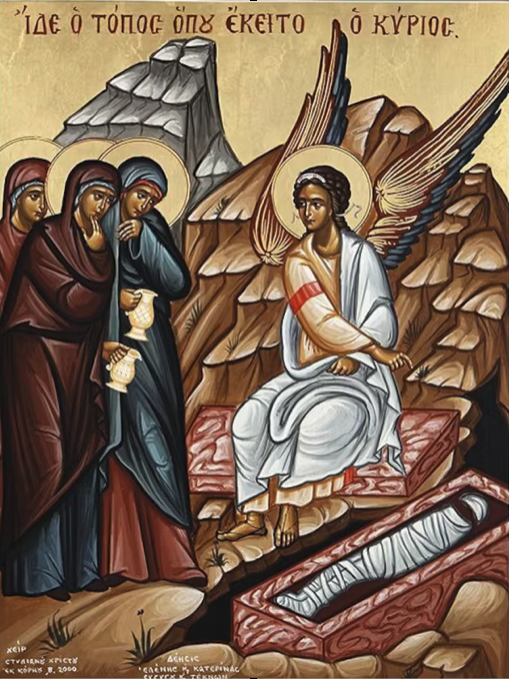
First, I have very little fear about the future of the Church. The long history of the Church has many times faced occasions of encountering deaths and resurrections. I am most often surprised that the Church has endured this long. Likewise, I have not a clear picture of what it might look like, just like the resurrection account found in John’s Gospel, where Mary Magdalene does not recognize Jesus at first, but thinks it is the gardener. This is all to say why this icon of the myrrh-bearers at the tomb assists me. It tells an important story for us and I find it assists me in lessening my fears and giving me hope.
The myrrh-bearers at the tomb is found in all four Gospels, so it is an important story. Each Gospel names Mary of Magdala (Magdalene), and other women are named in the synoptics of (Mark, Matthew and Luke). Luke adds names and unnamed women indicating a fairly large group. Depending on how you work with these accounts I find that it is a group, two or three gathered, is significant. I will return to the women shortly, let me first turn to refreshing us on the story.
The women came to the tomb, because Jesus had been crucified shortly before the start of Sabbath, which meant ceasing all work-related activities, including anointing bodies in burial. So, the women returned early on the next day, Sunday at first light as most Gospels tell. When the women came to the tomb, they encounter a messenger, an angel, who surprises them by announcing that Jesus was no longer here as Jesus was raised from the dead. The angel also directs the women to go and tell the news to the followers, the disciples. Depending on which account you work with, we have adopted the tradition that the women, though fearful and filled with joy, went and proclaimed to the disciples the good news of the resurrection. For many scholars this also signifies women as apostles, as the Greek word means ‘one who is sent.’ This ends the reading.
So, what does this have to do with the question of the future of the Church. Let me share how I use this. First and foremost is that our assurance as Christians is centered on love, in ‘that nothing, not even death, separates us from the love of God which is in Christ Jesus our Lord.’ So, just like the women who loved Jesus deeply as they attended to the work in their grief, shock and sorrow to anoint his body and acknowledge his death, we too must always be courageous and centered in furthering our work at hand in the hopes of the resurrection. By doing so, we too place our trust in that the Spirit will send us off to proclaim the new transformed body of Christ into the world.
I trust deeply that the Church in experiencing the current sense of loss is centered in the hope of that resurrection. It is unsettling to be in this space where the expectations of doing the familiar work, like the myrrh-bearers anointing a body, is shifting and changing. Yet we hold onto the hope that this work will be also transformed into new work.
So, my friends in God, as we proceed with the transformation of the Church in its process of loss toward resurrection, let us also be centered in the myrrh-bearing women. Let us go to the tomb with courage! Let us be ready to be stirred by the Spirit and embrace with joy the new commission that God is calling us to be. This call is always to further the proclamation of the newness of life of our body, the Body of Christ, called the Church and its eternal mission of spreading God’s love.
This is how I navigate the future of the Church. I hope that this will work for you as well.
Peace
Fr. Doug
